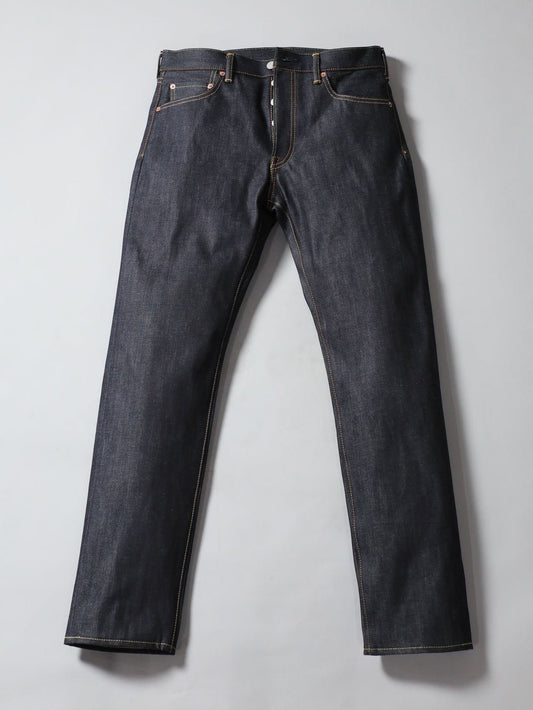
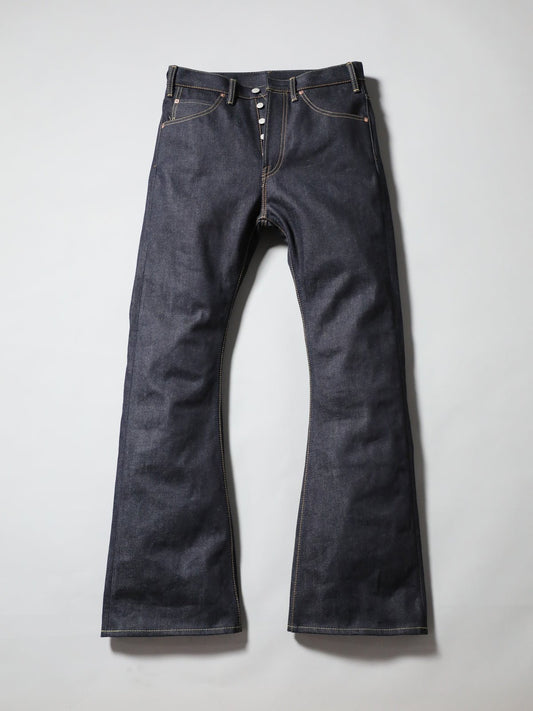
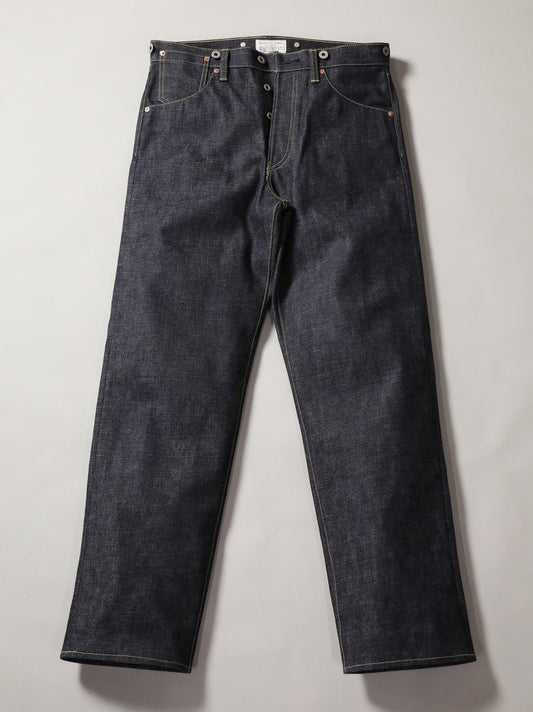
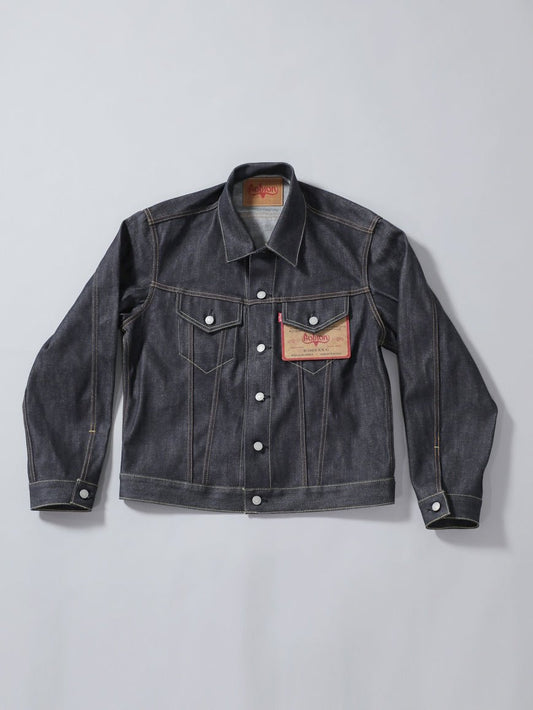
"These jeans are 14 ounces, so they have a solid fabric feel to them."
—If you love jeans, you have likely heard a conversation like this before.
"Ounces (oz)" is a unit of measurement indispensable when talking about jeans.
Why does this unit, which we don't hear often in daily life, appear so prominently in the world of jeans?
In this article, from the perspective of the jeans manufacturer BOBSON, we would like to carefully unravel what this "ounce" unit actually means.

(BOBSON's KD8 Jeans 510 reproduction has always used 14-ounce heavy-duty fabric)
Ounces measure "weight," not "thickness"
To begin with, this might be the point where most people are mistaken.
Ounces indicate the "weight" of the fabric, not its "thickness."
More precisely, it expresses the weight of the fabric per square yard (91.44 cm per side = 0.836 square meters) in ounces. One ounce is 28.35 grams. Therefore, "14-ounce denim" means that the fabric has a weight of approximately 14 x 28.35 = 396.9 grams per square yard.
The "thickness" and "sturdiness" of jeans that you feel on your skin often correlate with the weight of the fabric, so it is empirically common to speak of "ounces = thickness," but knowing that it is actually "weight" will make the following explanation much easier to understand.
Why express it in ounces?
The culture of jeans began in America.
Since it is a fabric born in a country that uses the yard-pound system, the indicator for showing the weight per unit area of the fabric naturally became ounces.
If it were a fabric born in France or Italy, the notation might have been "grams per square meter."
The remnants of history, that jeans came from America, remain today in the unit of "ounces."

The weight of a pair of jeans
Incidentally, the weight of denim fabric for one pair of men's jeans can reach about 600 to 700 grams. BOBSON's selvage denim series is 14 ounces, so it weighs around 1 kg.
Including leather labels and metal parts, the hefty feel you get when you hold a pair of jeans has a solid foundation.

What is the world's highest ounce?
Generally, fabric of about 6 ounces or less is called "lightweight,"
and 14 ounces or more is called "heavyweight."
Thin denim used for summer shirts and skirts is on the lightweight side, while 14 to 16 ounces is a standard guideline for sturdy men's jeans.
In recent years, even heavier-weight denim exceeding 20 ounces has appeared, which is the range that can be called the "world's highest" in modern times.
When it exceeds 20 ounces, it is 567 grams or more per square yard.
A single pair of jeans could weigh over 2 kilograms.
Weight is determined by "yarn thickness" and "weaving density"
There are two main factors that determine the ounces of a fabric.
The thickness of the yarn (cotton yarn) and the density (weaving) at which the yarn is woven.
Even with yarn of the same thickness, increasing the density makes it heavier, and decreasing it makes it lighter.
Taking the design of standard 14-ounce denim as an example,
the industry average is 7 count for warp yarn at 66 threads per inch, and 6 count for weft yarn at 44 threads per inch.
"The warp yarn is slightly thicker and has a higher density" is the basic grammar of jeans, but
it is surprising to think that 66 threads are packed into a short distance of just one inch.

What BOBSON values
Ounces are not just numbers; they are a very important indicator when considering whether those jeans are easy to wear as work clothes or daily wear.
Naturally, there are people who love the profound feeling of heavy ounces.
However, as BOBSON, we mainly offer jeans around 12 to 13 ounces, which are easy to wear as daily apparel.
Also, even in our thicker selvage series, our classic straight and flare types use 14-ounce fabric, while our overall types use a lighter 9.5-ounce fabric, which is somewhat thinner than other selvage fabrics; we carefully select the fabric according to the product and concept.
It is also an interesting attempt to look for a pair that suits your own preferences from the perspective of ounces, so we would be happy if you could use this as a reference moving forward.